Multi-Character Continuity: Keeping Stories Consistent
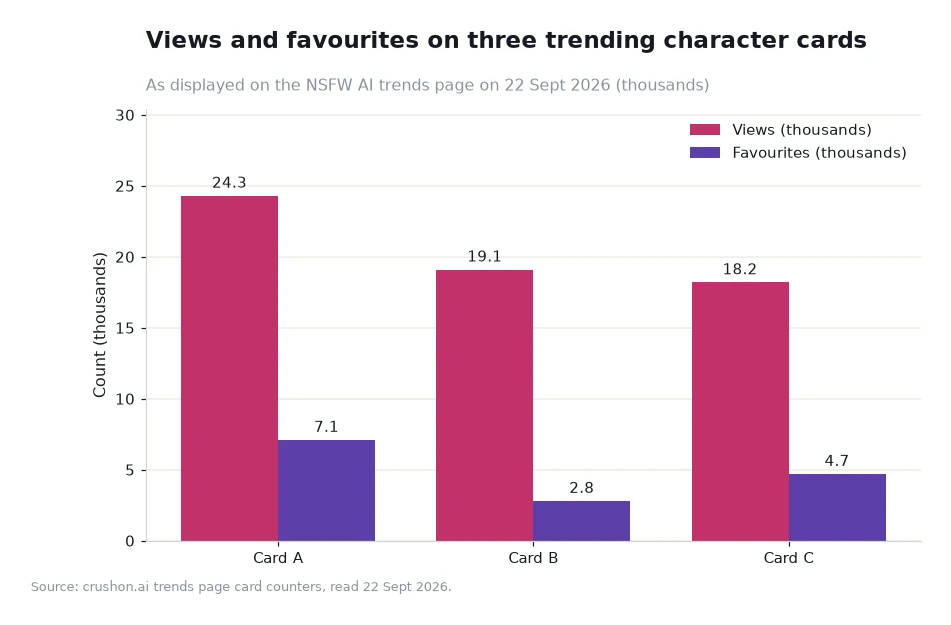
A story with three characters needs three sets of facts that do not contradict each other, and that bookkeeping is where most multi-character threads quietly fall apart. Crushon separates ongoing conversations from profiles — Memories on one side, Characters on the other — so a cast is really a set of parallel threads that have to agree. The counters on the trends page show how much repeat attention a single profile attracts: 7.1K favourites against 24.3M views on the leading card is a rate of about 0.029%, and anything you want held across a whole cast has to live somewhere other than a single thread.
Key takeaways
- Treat each character as its own thread with its own state, then keep one shared canon document outside the platform.
- Crossovers fail on specifics, not on tone: names, dates and what each character already knows are the usual contradictions.
- The trends page ranks 20 profiles each week, and top cards run from 24.3M views down to 18.2M — scale, but not a guarantee of consistency.
- A three-character story at two sessions a week each of 25 minutes is about 10 hours a month, which is the real budget to plan against.
One canon, several threads
Continuity across a cast is a data problem before it is a creative one. Each profile carries its own history, its own tone and its own relationship to the reader, and none of those threads can see the others. That is reasonable behaviour for a system built around individual characters, and it puts the coordination work where it belongs: with the person who decided to run a story with three leads instead of one.
The practical answer is a canon note kept outside the platform, and it does not need to be elaborate. One page with a row per character, holding a fixed description, the current situation, and a short list of what that character knows about the others, covers ninety per cent of continuity problems. Everything else is style, and style is far more forgiving than fact.
There is a second reason to keep the note. A story that spans weeks will outlive your recall of it. Reading your own summary before opening a thread restores the frame in seconds, which is the difference between continuing a scene and rebuilding it.
Where crossovers break
The first failure is knowledge bleed. A character who was not present when something happened should not refer to it, but once you have written that event in two threads, the temptation to let it travel is strong. The canon note is the guard: mark who witnessed each event, and check the row before a scene rather than after.
The second is register drift. Profiles built with different personalities will answer the same prompt differently, which is exactly the point, but readers who start a crossover usually want the differences to stay stable. If one character's register shifts by the third session, the cast stops feeling like a cast. The third failure is naming: two characters sharing a first initial, or a place name used in two threads with different details, is enough to make a scene unreadable a week later.
| Record | What goes in it | Check before a scene |
|---|---|---|
| Character row | Fixed description and register, kept to two lines | Does this reply sound like the same character as last week? |
| Current state | Where the thread sits right now, in one sentence | Does the new scene continue it rather than restart it? |
| Knowledge list | What this character knows and who told them | Has anything been referenced that this character never learned? |
| Shared facts | Dates, places and names used in more than one thread | Are the spellings and details identical everywhere? |
| Open loops | Promises, debts and unfinished business | Is anything closed here that another thread still needs? |
Worked example: sizing a cast against the counters
Start with the numbers on the cards. Card A shows 24.3M views and 7.1K favourites. Card B shows 19.1M and 2.8K. Card C shows 18.2M and 4.7K. Convert each pair into a rate by dividing favourites by views: 7,100 ÷ 24,300,000 = 0.000292, or 0.029%. Then 2,800 ÷ 19,100,000 = 0.000147, or 0.015%. Then 4,700 ÷ 18,200,000 = 0.000258, or 0.026%. Card C has about 5% fewer views than Card B and roughly 68% more favourites, which is the clearest sign of the three that repeat readers behave differently from first-time visitors.
Now apply the same logic to a cast. Take three characters, two sessions a week each, 25 minutes a session. That is 3 × 2 = 6 sessions a week, or 24 sessions a month, and 24 × 25 = 600 minutes, or 10 hours a month. Add the canon note — say 20 minutes a week to update, which is 80 minutes a month — and the total is roughly 11.3 hours. Those figures are illustrative assumptions, not platform data, and they are worth writing down because the canon note is the first thing readers drop when time is short, which is also when continuity suffers most.
Keeping the cast findable
Bookkeeping aside, a cast still has to be reachable. Ongoing threads live under Memories, which is the correct home for a story in progress, while new or replacement profiles are found through the character search page. Readers who want to see which profiles hold attention this week can check the NSFW AI trends chart, and the platform's own description of its ai porn chat pages explains how profiles and conversations are meant to work together. Its FAQ also answers what Porn Chat AI means and which limitations apply under the content and community guidelines, which is worth knowing before a long arc depends on an assumption.
Two small habits keep a cast from sprawling. Do not open a fourth thread while one of the three has an unresolved scene, and close an arc in every thread before starting the next shared event. Both rules push work back into the canon note, where it is cheap, instead of into the threads, where it is expensive to repair.
Frequently asked questions
Do characters in different threads know about each other?
No. Each conversation carries its own history, so a character only knows what has been said in their own thread. Anything that should be shared has to be introduced deliberately in each thread that needs it.
How much detail does a canon note need?
Less than most people expect. A fixed two-line description, one sentence of current state, a short knowledge list and any shared dates or names will prevent nearly every contradiction, and it takes minutes a week to maintain.
What is the most common cause of a dropped crossover?
Knowledge bleed: a character referring to something that happened in a thread they were not part of. Checking the knowledge list before a scene removes almost all of it.
Write the canon before the scene
Before your next shared scene, spend five minutes updating the canon note: current state for each character, any new shared fact, and which open loops are still running. Then open one thread at a time and keep each reply inside what that character can plausibly know. Consistency across a cast is not a feature you switch on; it is a small amount of paperwork, done regularly, by the only participant who can see the whole story.
Data and sources: the view and favourite counters shown on the NSFW AI trends page and the platform's product description[1], read 22 Sept 2026. Session, cast and canon-note figures are illustrative assumptions, not platform data. Written for readers aged 18+.