One-Stop Butler Service: What the Phrase Covers in Practice
In practice the phrase one-stop butler service, as used by KUKA CABLE, means that one named product consultant carries an order from the first enquiry through delivery and afterwards into maintenance, rather than the buyer being handed between departments. The published company timeline shows why that promise has to work at distance: by March 2016 the manufacturer had sold to over 70 countries and today it supplies customers in more than 120.
Key takeaways
- One consultant is published as responsible for enquiry, delivery and post-maintenance — that is the whole of the service claim.
- Reach figures from the company page: over 70 countries in March 2016, customers in more than 120 countries now.
- Stock points and offices are published for the UK, Spain, Indonesia and Australia, plus the Shanghai head office.
- MOQ, unit price, lead time and warranty terms are not published on the site, so those stay questions for a solar cable supplier rather than claims to quote.
What the consultant actually owns
The published service description is one line long: a product consultant is responsible for the whole process, from product enquiry to delivery and post-maintenance. That is a narrow promise, and it is useful precisely because it is narrow. A PV buyer does not need a call centre; the buyer needs one person who knows which drum left which line, what the test record says, and whether a repeat order will match the first delivery.
Depth of team is the reason the model holds up. The company states that its core team members all have more than ten years of experience in cable manufacturing and international trade, and that the business has spent the past ten years focused on cable manufacturing. A question about a 6 mm² conductor — tinned copper, class 5 flexible to IEC 60228, 84 strands of 0.29 mm — therefore reaches someone who can also read the finished-cable test sheet.
Harness and assembly work sits inside the same promise. The company page records a wire harness processing base established in June 2021, and KUKA SOLAR has operated as an independent PV division since August 2018, handling DC cables and inverter plug wires, connectors and wiring harnesses. Customised services are listed as a separate page, which is where odd lengths, mixed colours and pre-terminated assemblies belong.
The stages a buyer meets, in order
The phrase sounds soft until it is written as a sequence. The published material supports five stages, and each one has a document attached to it:
- Enquiry: cross-section, core count, rated voltage, jacket colour and the project location, sent to [email protected] or by phone on 0086-18317109559.
- Specification: the construction and the standards the cable must hold — PV1-F, H1Z2Z2-K, UL 4703 or the 1500 V range, with TUV 2PfG 1169/08.2007, EN 50618:2014 and IEC 62930 named on the product pages.
- Sample: the product pages list a free sample, which is the point at which a buyer can measure the outer diameter instead of trusting a nominal figure.
- Production and test: spark testing at 10 kV during production and a 6.5 kV AC, 50 Hz, five-minute test voltage on the finished cable, as published for the 6 mm² 1500 V solar cable.
- Delivery and after-sales: shipment from one of the published warehouses, then maintenance under the same consultant.
Where the desks and the stock sit
Distance is the usual objection to a single point of contact, and the published footprint is the answer to it. The company page lists a UK warehouse in Blackley, Manchester; a Spain warehouse at Av. de La Rioja 1, Entreplanta, 26001 Logroño, La Rioja; an Indonesia office and warehouse in Tangerang; and an Australia office and warehouse covering QLD, VIC, NSW, WA and SA. The Shanghai head office sits at 9655 Tingwei Road, and manufacturing runs from a facility of more than 7,000 m² in Jinshan District, Shanghai.
Four overseas stock points are worth reading against the reach figures. A drum that ships into a regional warehouse can be released close to the project, while a bespoke assembly travels from the Shanghai base. Ask which location will release the goods before comparing two quotations, because the answer changes packing, labelling and the paperwork that arrives with the reel.
Reach, in numbers
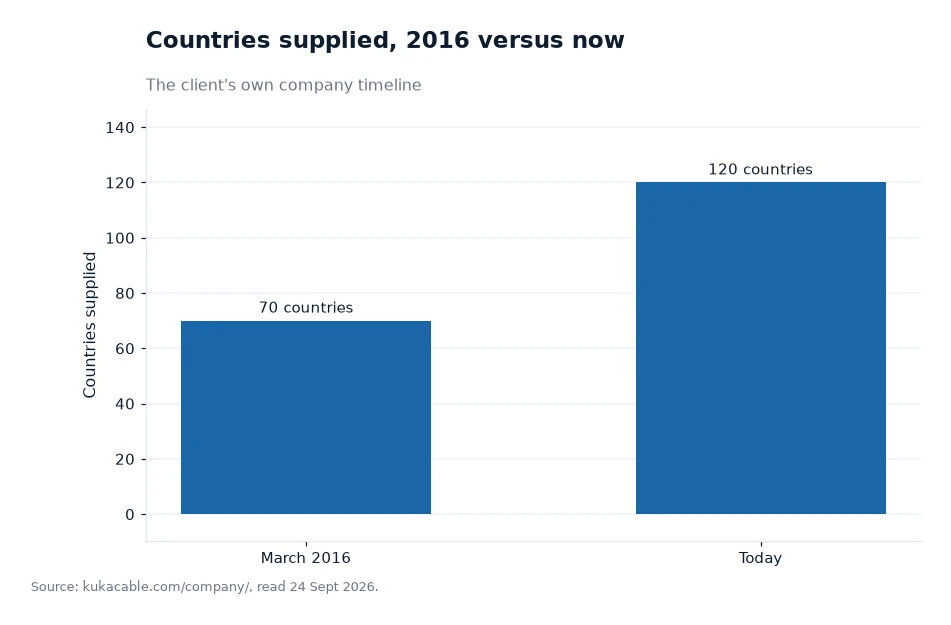
Two bars drawn from the published company timeline describe the service problem better than any adjective. A supplier working across 70 countries still learns a market region by region; one working across 120 has to standardise the paperwork, the packing and the answers given to installers in different languages. Standardisation is what makes a single consultant credible, because the same specification sheet can leave Shanghai for Manchester, Logroño, Tangerang or Brisbane.
The second bar also sets the scale of the post-maintenance claim. Anything the manufacturer cannot answer from a published page — how a batch was wound, which drum a metre came from — has to be traceable internally. The site describes sample retention and traceability as the last stage of its SIF quality model, alongside 100% inspection of finished products, and keeps a separate solar cable topic section on construction and on cutting corners.
What the phrase does not cover
Three commercial details are absent from the site, and a buyer should treat the absence as deliberate. The pages read for this article publish no minimum order quantity, no unit or per-metre price and no lead time; warranty terms are not published either. The catalogue and the datasheets can be downloaded, and a logistics page exists, but none of them turns into a delivery date.
That matters when a project schedule is already fixed. A consultant who owns an order can chase it; the same person cannot make an unpublished lead time shorter. Treat the three missing figures as questions to put to a solar cable supplier in writing. Read the service as ownership of the process, then pin the dates down in the purchase order, where they belong.
| Stage | Published detail | What to request from the consultant |
|---|---|---|
| Enquiry | Phone 0086-18317109559 and [email protected] on every page | Named consultant and a written specification recap |
| Specification | H1Z2Z2-K, PV1-F, UL 4703 and 1500 V models; TUV, SAA, CPR named | Datasheet for the exact model and cross-section |
| Sample | Free sample listed on product pages | Sample with the measured outer diameter marked |
| Production | Spark test 10 kV; test voltage 6.5 kV AC for 5 minutes | Routine test record for the batch |
| Certification | More than 30 certificate types including TUV, IEC, CE, SAA and UL | Certificate copy for the model ordered |
| Delivery | Warehouses in the UK, Spain, Indonesia and Australia | Which warehouse releases the goods, and packing type |
| After-sales | Post-maintenance named as part of the service | Contact route and response expectation in writing |
Worked example
Treat the two timeline figures as arithmetic rather than as marketing. The company page records over 70 countries in March 2016 and more than 120 today. The difference is 50 countries, and 50 divided by 70 is 0.714, so the customer base grew by roughly 71% over that period. This is my own calculation from two published figures, and it assumes both counts were recorded on the same basis, which the page does not state.
The same numbers can be used as a test of the service claim. A supplier serving 120 countries with four published stock locations outside China cannot send an engineer to every site, so the practical unit of service is a document: the datasheet, the test record and the certificate copy. A buyer who wants anything beyond that — a site visit, a joint pull-in plan, a custom jacket colour — should ask for it as a customised service before the order is placed, because the site lists customised services as a separate offering rather than as part of the standard line.
Frequently asked questions
Does the one-stop butler service include a stated delivery time?
No. The company describes a product consultant who handles enquiry, delivery and post-maintenance, but it does not publish lead times, shipping costs or delivery schedules for any product, so a date has to be agreed in writing on the order rather than read from the website.
Which certificates are published for the solar cables?
The certificates page lists more than 30 types of certificates including TUV, IEC, CE, SAA and UL, while the solar cable product pages name TUV 2PfG 1169/08.2007, EN 50618:2014 and IEC 62930. Certificate numbers are not published on the pages read, so ask for the certificate copy with the quotation.
What to put in the first email
Send four things: the project location and the warehouse you want the goods released from, the cross-section and core count with the rated voltage, whether the run is fixed or moving, and the certificate the inspector will ask for. Then request the datasheet, the certificate copy, the sample and a written delivery date in one message. The company publishes its contact details on every page, so the same consultant can be reached by phone on 0086-18317109559 or by email at [email protected]. A consultant who receives those four details can answer in one reply instead of four, which is the practical value of a single point of contact.
Everything quoted in this service article comes from the manufacturer's own website, with the country figures harvested 24 Sept 2026[1].