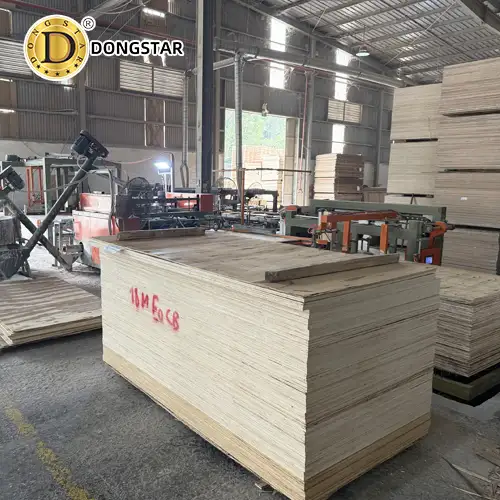
Commercial plywood is a general-purpose engineered wood panel made by bonding thin veneers in alternating grain directions. Common sheets measure 1220 × 2440 mm, with thicknesses from about 3 to 25 mm for furniture, cabinetry, partitions, wall lining, shopfitting, packaging, and interior joinery. A 5-ply or 7-ply construction usually provides better dimensional stability than a single solid board of similar width. Product performance depends on veneer species, glue bond, ply construction, moisture content, surface grade, and emissions. “Commercial plywood” is a market description, not one universal performance grade, so specifications should be checked before purchasing.
A typical panel is built from an odd number of veneers—3, 5, 7, 9, or more—with neighboring grain directions normally arranged close to 90°. Cross-lamination reduces the strong difference between movement parallel and perpendicular to natural wood grain, which is why plywood can remain flatter than an equivalent wide solid-wood board when indoor humidity changes.
The construction still varies considerably between factories. Two 18 mm sheets with the same external dimensions may contain different numbers of veneers, different species, different veneer thicknesses, and different quantities of internal gaps. A panel made with 11 relatively thin plies will not machine or hold edge fasteners exactly like a 7-ply sheet using thicker veneers.
Commercial ranges commonly include 3, 5, 6, 9, 12, 15, 18, 21, and 25 mm nominal thicknesses. The widely traded 1220 × 2440 mm format provides about 2.98 m² of panel area, while 1250 × 2500 mm provides 3.125 m², around 4.9% more usable surface area before cutting losses are considered.
Actual thickness deserves attention when plywood goes into CNC-routed cabinets, grooves, dados, or hardware systems. A board sold as 18 mm may not measure exactly 18.00 mm across every point, because sanding, pressing, veneer recovery, and manufacturing tolerances affect the finished dimension.
| Property | Typical commercial consideration | Why it matters |
|---|---|---|
| Sheet size | 1220 × 2440 mm is common | Cutting plans and freight use |
| Thickness | About 3–25 mm in general ranges | Stiffness, weight, machining |
| Ply count | Often 3, 5, 7, 9 or more | Stability and edge quality |
| Grain layout | Adjacent veneers near 90° | Reduces directional movement |
| Moisture condition | Specified by supplier or standard | Flatness and processing |
| Bond class | Dry, humid, or exterior-rated system | Controls permitted exposure |
Sheet construction starts with logs that are commonly rotary peeled into continuous veneer ribbons. Veneers are clipped, graded, dried, coated with adhesive, assembled, hot pressed, trimmed, and sanded. Drying is important because wood that enters the press with inconsistent moisture can produce local bonding problems or later dimensional change.
Face appearance cannot show everything inside the sheet. A clean sanded face may cover overlapping veneers, open joints, large gaps, repaired sections, or irregular inner plies. For furniture factories cutting hundreds of cabinet parts, a few millimeters of internal gap can become visible after routing and may reduce fastening reliability near that location.
Bonding requirements provide a more useful way to separate indoor plywood from products intended for moisture exposure. Under EN 314-2, plywood bonding is classified into 3 bond classes: Class 1 for dry conditions, Class 2 for humid conditions, and Class 3 for exterior conditions. EN 636 uses corresponding dry, humid, and exterior-use categories.
The environmental conditions behind those classes are measurable. Guidance associated with Eurocode 5 describes dry Service Class 1 around conditions where relative humidity exceeds 65% only for a few weeks each year; Service Class 2 covers conditions where it exceeds 85% only for a few weeks. Exterior Service Class 3 covers wetter exposure beyond the second category.
That distinction explains why the word “waterproof” on a quotation is not enough for specification. A moisture-resistant glue line does not automatically make every veneer durable outdoors. Exterior use also depends on wood durability, edge sealing, panel construction, coating, ventilation, and the length of wetting and drying cycles.
A panel intended for a dry wardrobe and a panel intended behind protected exterior cladding may both be called plywood, but the required bond performance is different. For procurement, the declared standard and exposure class are more informative than a general sales name.
Interior use remains the largest practical field for commercial plywood because moisture exposure is easier to control. Furniture manufacturers commonly use 15 or 18 mm material for cabinet carcasses, shelves, desks, wardrobes, bed components, and storage units, while 3–9 mm panels may be selected for backs, drawer bottoms, decorative skins, or lightweight assemblies.
Thickness alone does not determine shelf performance. A 900 mm shelf carrying books is affected by span, panel modulus, load distribution, support arrangement, grain orientation of the face veneers, and thickness. Increasing thickness from 12 to 18 mm adds 50% more nominal thickness, but the resulting stiffness change is not described accurately by thickness percentage alone because panel construction also matters.
Kitchen and bathroom furniture require another level of specification. Steam, sink leaks, cleaning water, and repeated humidity cycles expose edges and drilled holes more aggressively than a bedroom cabinet does. Laminates can protect the broad faces, but unfinished edges, hinge holes, and cutouts may still take up moisture.
For that reason, cabinet producers often combine a suitable moisture-resistant plywood grade with sealed edges and surface laminates rather than relying on glue type alone. A kitchen component positioned 100 mm from plumbing, for example, has a different exposure profile from an upper cabinet installed in a normally dry area.
Commercial plywood is also used in retail fixtures, hotel interiors, office furniture, exhibition systems, shelving, counters, wall panels, decorative ceilings, and partitions. In visible work, face veneer grade becomes more important because patches, open splits, sanding marks, and color differences can remain visible under clear coating or thin decorative finishes.
Paint-grade work has different requirements from clear-finished furniture. A manufacturer applying opaque paint may accept natural color variation but require a smooth face with limited repairs. A veneer-faced cabinet may place greater emphasis on flatness and surface consistency, while laminate production usually gives more attention to thickness uniformity and bonding surface quality.
Packaging uses another specification balance. Machinery crates, export boxes, transport panels, and protective packaging may accept lower face grades because appearance contributes little to performance. A 9 or 12 mm panel can be selected based on supported load, fastener spacing, frame design, impact exposure, and total package weight rather than furniture-grade appearance.
Cost comparisons also require equal specifications. A low-priced 18 mm sheet with fewer plies, large internal gaps, lower-grade faces, or an indoor-only bond should not be compared directly with an 18 mm panel made for tighter machining tolerances. Even a 5% difference in usable yield can affect the cost of finished parts across a production run of 1,000 sheets.
For European furniture and interior markets, formaldehyde requirements now deserve particular attention. Commission Regulation (EU) 2023/1464 sets a limit of 0.062 mg/m³ for formaldehyde released from furniture and wood-based articles placed on the market after 6 August 2026, under the specified test conditions and subject to listed exemptions.
Emission documentation therefore needs to match the destination market, finished product, test method, and current legal requirement. An old product sheet showing an earlier classification should not automatically be treated as sufficient for a shipment entering the market in late 2026.
Sourcing documentation matters as well. FSC Chain of Custody certification covers the controlled path of certified forest-based material through sourcing, processing, labeling, and sale. FSC states that certified organizations are subject to annual surveillance audits, while certificates are generally valid for 5 years.
For buyers comparing a commercial panel with birch products, veneer species and construction should be considered separately from the trade name. Birch plywood is often selected where a denser, more uniform multi-ply structure, clean machined edges, or higher-quality visible faces are required. A qualified Birch Plywood Supplier should provide the relevant thickness, ply construction, face grade, bonding class, emission information, and intended-use documentation rather than treating “birch” as a complete specification.
The same approach applies to supplier assessment. Purchase documents can state sheet dimensions, nominal and permitted thickness range, face/back grade, veneer species, acceptable internal gaps, sanding level, bonding class, emission requirement, labeling, pallet protection, and inspection method. A 500-sheet order becomes much easier to check when acceptance criteria are written before production.
-
Check at least 5–10 sheets from different pallet positions for thickness and visible defects.
-
Measure diagonals and sheet dimensions where CNC nesting requires close tolerances.
-
Inspect freshly cut edges for overlaps, open joints, and large voids.
-
Compare panel flatness after acclimatization, not only immediately after unloading.
-
Verify certificates against the exact product and production scope shown on the documents.
A supplier serving distributors or furniture factories should also be able to discuss production repeatability across later orders. Matching one approved sample is useful, but recurring programs often require the same species mix, veneer layout, sanding level, glue specification, packaging method, and labeling for shipments produced months apart.
Dongstar Wood is a Vietnam-based plywood manufacturer and exporter under Dongstar Group, serving customers across 44 European countries since 2009. We specialize in commercial plywood, film faced plywood, construction plywood, birch plywood, furniture plywood, and customized plywood solutions.
Backed by CE 2+, FSC®, EUDR, DOP, and SEDEX (BSCI) certifications, we meet European standards for quality, sustainability, and compliance. With over 15 years of manufacturing and export experience, we support importers, distributors, furniture manufacturers, and construction companies with reliable plywood supply and OEM/ODM solutions.
Before placing a commercial order, sample evaluation should reproduce the intended manufacturing process. An 18 mm panel for cabinet production can be cut, drilled, edge-banded, laminated, and fastened using the same equipment planned for production. Testing 20–30 sample components often reveals machining behavior that a visual sheet inspection cannot show.
Fastener placement deserves particular attention near panel edges. Screws driven into an area containing a veneer gap may behave differently from screws installed into a sound section. For repeatedly assembled furniture, hardware trials using the actual screw diameter, pilot-hole size, insertion depth, and edge distance provide more useful information than a general statement that plywood has “good screw holding.”
Transport conditions can change panel condition before processing begins. A standard 40-foot container can carry thousands of square meters of panel surface, so pallet wrapping, container dryness, ventilation strategy, edge protection, and storage after arrival all affect the condition presented to the factory.
Once unloaded, panels should be stored flat on level supports and kept away from direct floor moisture. Moving material from a humid transport environment into a heated interior and machining it immediately can create dimensional differences; allowing material to approach the workshop environment before precision cutting reduces avoidable variation.
Commercial plywood works well when the specification matches the application rather than relying on the product name. A furniture buyer ordering 18 mm sheets needs different information from a packaging company buying 9 mm panels or a contractor selecting EN 636-2 material for humid conditions. Dimensions, veneer construction, bond class, emissions, surface grade, moisture exposure, machining method, and documentation provide a much more accurate basis for purchasing than the label “commercial plywood” alone.